
Vue templates internationalization
<p>Hello world!</p>
⬇
<p>{{ $t('helloWorld') }}</p>
<!-- locales/en.js: helloWorld: 'Hello world!' -->

<p>Hello, {{ user }}!</p>
⬇
<p>{{ $t('hello', {user: user}) }}</p>
<!-- locales/en.js: helloWorld: 'Hello, {user}!' -->

<p>Hello, {{ user }}!</p>
⬇
<p>{{ $t('hello', [user]) }}</p>
<!-- locales/en.js: helloWorld: 'Hello, {0}!' -->
Features supported
- Hardcoded strings extraction
- Automatically extract strings in bulk
- Extract selection
- Register a missing key
- Navigation to translation
- Localization hints
- Rename keys and placeholders
- Ignore strings by content
Configure hardcoded strings extraction from Vue templates
The plugin should automatically configure itself for project with dependencies on vue-i18n and nuxt-i18n, but adjustments could be needed for custom setup.
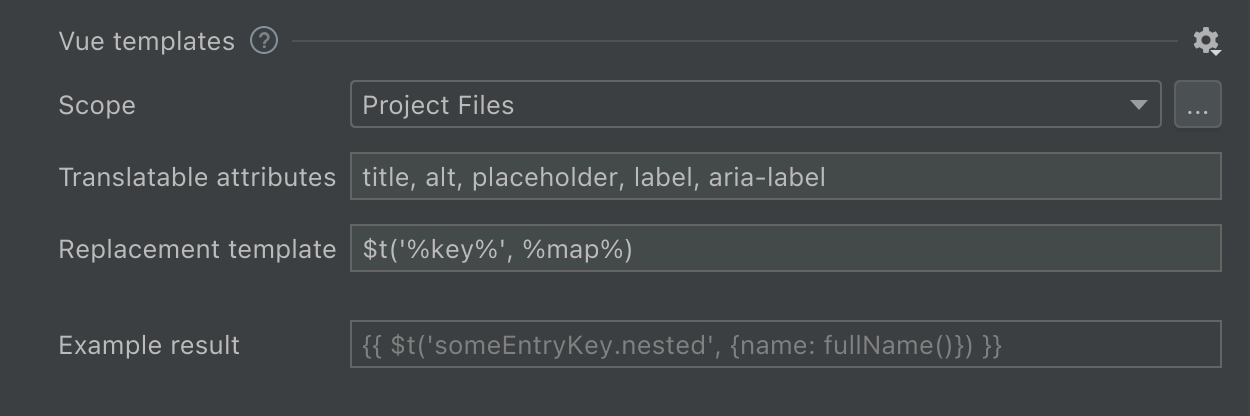
Scope
i18n Ally is applying inspections for files that have .vue extension and are included into
a PhpStorm’s scope.
Create a new scope or adjust existing by clicking on … button and handpicking only the meaningful directories and files.
Select Project files to include all .vue files in your project.
Inline tags
Extraction of strings with a special treatment of inline tags is not currently supported.
Translatable attribute names
Translatable attributes are also checked for the translatable text:
<img src="…"
     alt="Checked by default"
     title="Checked by default"
     data-content="Requires configuration" />
You can add custom attributes, like data-content, by appending a new attribute to the comma-separated list.
Replacement template
The “Replacement template” reflects the result of the hardcoded string extraction.function name and arguments template.
Recommended value for vue-i18n and nuxt-i18n packages: $t('%key%', %map%).
%key%
Short key or a natural language string that defines a translation.
%namespace%
Namespace (called ‘domain’ in Symfony) usually means a part of language file path from where translations would be searched for. The default
namespace is usually messages, but could be changed by putting a namespace in first position in “Namespaces” field.
%map%
If there are no variables in the string, then nothing would be added.
Map will be replaced with an object if there are any placeholders detected:
$t('key', {foo: fooVariable, bar: barVariable}).
Placeholder names will be determined automatically based on a respective variable, function or method name.
In language files placeholder syntax will be determined based on the Placeholder format setting of the language file.
%list%
If there are no variables in the string, then nothing would be added.
List will be replaced with an array if there are any placeholders detected:
$t('key', [fooVariable, barVariable]).
In language files the ordered placeholder syntax {0}, {1} will be enforced.
%varargs%
If there are no variables in the string, then nothing would be added.
Varargs will be replaced with placeholder passed directly to the translation function if there are any placeholders detected:
$t('key', fooVariable, barVariable).
In language files the ordered placeholder syntax {0}, {1} will be enforced.
Supported language constructs
All strings inside tags and translatable attributes are checked.
What’s not supported
- Extracting strings from expressions, like
{{ someFunc('Hello world!') }} - Reading and extracting keys from a
<i18n>tag within single-file components - Renaming key names from language files
What strings are skipped
- All attributes except ones listed in “Translatable attribute names” preference.
- Strings that looks like code: without letters, multiple words without spaces or
camelCasedones.
Best practice: dealing with branching in messages
It’s common to have small and simple branching for presentation purposes:
Webhook {{ isSuccess ? 'succeeded' : 'failed' }}.The best practice it to separate this message into two different ones so translators would have a full context and would be able to adjust word order according the target language grammar.
1st step: manually extract the condition out of the message to get two messages without condition
<template v-if="isSuccess">Webhook succeeded.</template>
<template v-else>Webhook failed.</template>
2nd step: replace simple messages with i18n Ally
<template v-if="isSuccess">{{ $t('webhookSucceeded') }}</template>
<template v-else>{{ $t('webhookFailed') }}</template>